![]() |
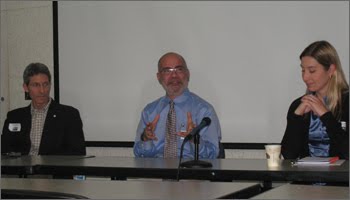
| PR Chair for IFMA SF, Carmina of Infuse Marketing (in red) presents social media benefits to chapter members. |
Visit News from IFMA San Francisco to learn about speaker/tour guide insights, members' feedback from programs and events, sustainability, green initiatives and other chapter news. Got facility management questions? Post them - maybe your peers have the answers! Use the IFMA-SF blog to share your opinions, experience, creativity and ideas to enrich the FM community in the Bay Area.
August 23, 2012
Social Media for Facility Managers
June 13, 2012
Sustainable Landscaping ROI
Bay-Friendly | Eco-Friendly Landscaping Alternatives Lead to Cost Savings
In this video, ValleyCrest Landscape Maintenance partnered with Electronic Arts in Redwood Shores to implement the following GREEN landscaping solutions:
- Irrigation Retrofits
- Sustainable Plant Replacement
- Herb/Vegetable Garden Conversion and Creation
- EA realized the following benefits and cost savings:
- Total annual savings of 1,102,552 gallons of water
- Reduction of 9,450 pounds of green waste per year
- Production of 416 pounds of edible vegetables and herbs per year
![]() |
| http://construction.com/aboutus/2010/1112pr.asp |
If you go GREEN, you can expect your organic waste generated from landscaping to drop an average of 5% per year; gas costs based on sustainable tree pruning techniques to drop 2.5% per year on average and water consumption per square foot to go down an average of 9% a year. Depending on how aggressively you pursue green landscaping recommendations, you could enjoy even more resource savings.
![]() |
| http://www.valleycrest.com |
- Plant landscapes suitable to the micro climate or native to the area for greater sustainability
- Replace turf and energy-intensive plant materials with San Francisco Bay-Friendly and sustainable plant palettes
- Plant chef and employee organic gardens on site
ValleyCrest Landscaping Management
www.valleycrest.com
May 1, 2012
Green, Sustainable, LEED Certified, Energy Efficient, Energy Star, Carbon Neutral = Green Paralysis
I suggest you take GREEN out of the discussion and focus on how you can run a facility as efficiently as possible. Focus on energy, waste, and water reduction,increasing your efficiency per square foot, having a lower operating expense than your neighbor buildings, and getting your waste bills as low as possible. Then integrate energy star ratings or LEED which have both shown to produce increased rents of up to $11 and increased occupancy of 4% based on research by Co-Star. March 15, 2012
Be Smart - Save Money - Be Water Wise
February 12, 2012
Managing Plug Load - The Next Challenge for Energy Efficient Buildings
"Plug load? Seriously? With all the things that I need to do in my facilities you want me to worry about managing plug load power use? It can’t be that big a deal."
Studies from many countries consistently show that “miscellaneous” load is a quarter to a third of power consumption in office buildings, and it keeps growing as facilities become “smarter”. When HVAC and lighting get more efficient, plug load can be 50% or more of energy use. Recent research from UC-San Diego shows that IT equipment accounts for more than 70% of electrical base load in “mixed-use” campus buildings that have server rooms. http://www.solaripedia.com/files/753.pdf Managing plug load power use is a big deal, and gets bigger as we put more electronic equipment into every type of building.
"So, what should I do?"
January 31, 2012
IFMA San Francisco Holiday Party at a Green Venue
| 2011 Holiday Party at the Intercontinental San Francisco |
![]() |
| Harry Hobbs facilitating a tour of the LEED Gold hotel |
January 12, 2012
Benchmarking Your Building or Facilities
Competition is fun and what gets measured gets done. So I am a natural advocate for the Energy Star process. Of course this star aligned with our pursuit of LEED certification gave us extra impetus to pursue the threshold score of 69. San Francisco as a city also found enough merit in the program to require it as well with an ordinance implanted this year. So even if you aren’t as excited as we are, it is becoming a fundamental.
I found that establishing a baseline carefully gave context to the projects we did in a way that simple ROI or other financial measures were lacking. The database is probably not perfect, but it has been normalized and refined now for about fifteen years and continues to evolve. I had a chat with some non-believers the other day who were arguing its frailties. They had the opinion that the ISO process was more rigorous and better designed, and it may be, but it lacks the name recognition of one of the most widely known logos in the world. For my money I would rather help Energy Star evolve than put effort into a system that is not as widely accepted. By the way our IFMA organization supports it too. http://www.energystar.gov/index.cfm?fuseaction=buildingcontest.index
http://www.ifma.org/resources/sustainability/energy-star-challenge.htm
![]() |
| Intercontinental Hotel San Francisco |
![]() |
| Harry Hobbs, CFM |
Director of Engineering
INTERCONTINENTAL HOTELS OF SAN FRANCISCO
December 8, 2011
IFMA Sustainability | SFP (Sustainable Facilities Professional) Certification Rollout
This year the San Francisco chapter of IFMA launched a major new initiative on Sustainability, including additional skill elements for the CFM certification and a new Sustainable Facilities The San Francisco chapter now has its own initiative for 2012. Next year's plan includes events, education and outreach to help promote the adoption of sustainable practices in Facilities Management. One element of the plan is the IFMA-SF Sustainability Minute, an opportunity for chapter members to participate in a short video recording at programs on a sustainability subject they know and believe in. The concept is to create an informal, informative and engaging one-minute talk on a specific issue and provide expert tips on what FMs should do to incorporate sustainable practices into their daily work lives. The videos will be promoted nationally through our chapter website and social media campaign. Accompanying the video, the featured speaker will also contribute to our blog. The blog post will expand on the video's subject with links to informational resources accompanied with a short bio.
A chapter Sustainability Committee has been formed to implement the Sustainability 2012 initiative. We welcome the participation of anyone who would like to help out. Our goal is to have IFMA-SF be a national leader in the drive to bring more sustainable practices to the profession of Facilities Management.
Richard Hodges
November 11, 2011
Thoughts on “Hoteling, Real Estate and the Evolution of Facilities” from an IFMA rookie
I am new to the Bay Area and to the San Francisco chapter of IFMA. Excited to get involved, I've joined the PR/Communications Chair headed up by Carmina Bacani. I attended October's program and assisted with event registration.David followed this with a presentation on the corporate reaction to mobile staffing. While some companies have no official policy on this issue, others are offering alternative locations, such as satellite suburb offices. Others, however, are completely revamping what the workspace looks like and what it provides. David’s presentation included several pictures of new workspaces, such as the “touchdown zone” (creating a coffee shop/airport lounge atmosphere in the office), the “home base” (having the smallest possible desks located very close together while creating other spaces to spend time), and “free addressing” (employees come in and work wherever they want whenever they want). The implications for facilities, he explained, is that they are now more open and adaptable with a smaller footprint, while the lines between workplace and residence have become blurred.
These presentations hit close to home for me for two reasons in particular. One is that I myself, am a very highly mobile worker; though I live in California, I am working for a professor at Penn State University. My workspace rotates between my bed, the living room couch, and Starbucks (not my favorite coffee perhaps, but the most reliable WiFi!). I have no real option of commuting into work, so the idea of the workplace has really been transformed for me. Additionally, as a human geographer by training, I’ve considered the reasons that particular companies locate in particular places (e.g. tech companies in Silicon Valley) and the implications of this, but have not thought much about how the actual real estate affects culture, productivity, collaboration, etc. I’m seeing a potential future dissertation topic…
Lauren M. Anderson
Fairfood International
September 13, 2011
Polk, Popos and Pedestrians: Exploring San Francisco a few blocks at a time.
On Friday Sept 9th, San Francisco IFMA members and guests took a two hour, three block Architectural tour of downtown San Francisco. This walk was led by Architect, and "soon to be published" researcher Rick Evans.
Though we toured a geographically small area of San Francisco's Financial District, members and guests' were educated on the neighborhood's history. That is, if we look up! There is much significance left and imprinted in the building's facade when onlookers look beyond street level.
Mr. Evans lead us through a number of privately owned, public spaces known as POPOS, showing us how easy it is to walk a block above the street, and how this space requirements will be implemented into future City developments.
Also during the tour we were introduced to the architect Willis Polk whose work had many significant works in this area of downtown, most notably the Hallidie and Hobart buildings.
Mr. Evans ended our tour by leading us across Market Street to the soon to be Transbay Terminal. Envisioned as the Grand Central Station of the West, centerpiece to a car free Downtown, terminus for the California High Speed Rail. This station redevelopment project now being looked at by the whole world as the working model of new urban development.
Edward Cooke, LEED AP
Member of IFMA, San Francisco
July 6, 2011
Carbon Accounting 101
There it is, in your calendar in that shade of red that shouts ‘important’, a meeting scheduled to allocate tasks for Greenhouse Gas (GHG/C02) reporting! Grab a cup of coffee before the meeting; you’ll need to be well caffeinated going in. If this has already happened in your organization then you’ll know how much data mining this requires, and I’d love to hear about your experience (see begging note at the end).
Why do we need to report GHG (C02) emissions?
There are regulatory (Federal, State & International) reporting requirements, customer requirements, leadership requirements, voluntary reporting as a business efficiency metric and risk management issues (SEC 10K disclosure requirements) to name an important few. Whatever the drivers for reporting carbon emissions, a lot of the work usually falls to the facilities/real estate folks.
If you have not been asked yet, this is a great opportunity to get out in front of this. If you’re currently grappling with this issue I hope you gain something of benefit from this and future blogs.
As of January, 2010 over 3,000 global companies report to the CDP (Carbon Disclosure Project), the Dow Jones Sustainability Index (DJSI) which rates companies by industry and sustainability performance and the FTSE4Good (Financial Times Stock Exchange index – UK) that rates companies for corporate responsibility and is used by ethical investors all over the world.
What do we need to report?
Under the GHG Protocol GHG emissions are expressed as tCO\2e.
t = metric tonnes (the metric system is used by the rest of the world, get over it)
CO2e = CO2 equivalent. This is the GWP (Global Warming Potential) as calculated and expressed as CO2 equivalency (e.g. 1 tonne of methane is equivalent to 21 tonnes of C02 (21 times more global warming potential) for an apple to apple comparison of various compounds.
There are six main GHG’s reported:
- Carbon dioxide (CO2).
- Methane (CH4).
- Nitrous Oxide (N2O).
- Hydrofluorocarbon (HFC)
- Perfluorocarbons (PFC)
- Sulfur Hexafluoride (SF6)
Baseline Year:
All emission reporting starts from a baseline year. This may be given to you, if you have any input into the base year, pick a year where you have good data. You’ll never have all the data you need easily available. Ask yourself; how much refrigerant did you use in 2006 broken down by chemical type (e.g. Scope 1: R-134A is a Hydrofluorocarbon with a GWP of 5,000)? How much diesel fuel was used in 2004 for testing of your emergency generators (also Scope 1)? You see what I’m getting at?
If you’re lucky your utility will have automated your facility energy use; expressed in Kwh in Excel or a similar format going back 5 or more years. If you have facilities in other parts of the country and internationally, you may face additional challenges in getting the information. After doing this for nearly 5 years, getting accurate data is by far the biggest issue we see. FM departments need to start accumulating this data and archiving it in a format that is easily accessed and as up-dated as necessary. GHG reporting is usually done Q1/Q2 every year, and don’t think it’s going away any time soon. We’re seeing a push for much more granularity in the data collected. Is this a chance for you to shine even brighter?
Scope Boundaries:
When reporting voluntarily the organization gets to set the reporting boundaries (However; the standards are expected to increase year on year).
- Scope 1: Direct emissions at owned facilities usually from on-site generation or process (burning fossil fuel and/or emissions of chemicals). These are directly under the control of the organization, as you select the fuel source or chemicals used and you own the process (e.g. fleet vehicles that are owned are scope 1).
- Scope 2: These are usually indirect emissions, and electricity is the most common scope 2 reported. The utility selects the fuel source and as such the emission has to be calculated based on the fuel mix used in that region by that utility. However if you also manage travel as part of your scope of services; business travel is also scope 2 based on miles traveled and mode of transport (mostly jet and vehicle fuel).
- Scope 3: This is everything else. If you take a close look at the FM supply chain there are a great many items that impact your emissions. Scope 3 is the next step as we work towards reducing total emissions. Extra credit: Asking your suppliers for their GHG reports as part of the *procurement process sends a strong signal that you’re serious (sends the right message to your boss too).
- *Wal-Mart did this recently and it sent a strong message to their suppliers and greatly changed the way they used resources. The data so far indicates that there has been no increase in supplier costs or availability of products.
What next?
That’s where you come in. I need you to tell me what you want to hear about; is it carbon accounting 102, abatement strategies or other sustainability issues? I’ll be happy to group the questions into a sort of FAQ section of this blog, but in order to do that I need your FAQ’s. To prime the pump, I’ll incentivize you by offering a Starbucks gift card ($10) for the *best FM sustainability question. You’ll need the extra caffeine once you start down the GHG road.
*I will be the sole arbiter of the best question and my decision is final (unless my wife disagrees, then we’ll go with that).

Extra reading credits:
Carbon Disclosure Project: https://www.cdproject.net/en-US/Pages/HomePage.aspx
Walmart / CDP: http://walmartstores.com/Sustainability/7759.aspx
Greenhouse Gas Initiative Protocol: http://www.ghgprotocol.org/
World Resources Institute GHG: http://www.wri.org/project/ghg-protocol
World Business Council on Sustainable Development: http://www.wbcsd.org/templates/TemplateWBCSD5/layout.asp?type=p&MenuId=MTAxMQ&doOpen=1&ClickMenu=LeftMenu
Bruce Thorpe.
Bruce is a Senior Associate at WSP Sustainability & Energy http://www.wspenvironmental.com/ . He leads WSP’s Sustainable Real Estate and Workplace practice in North America and is based in San Francisco.June 6, 2011
New CAL Green Code Requirements
San Francisco led the way for advanced green building codes in 2007 when then Mayor Gavin Newsom signed into law the city’s first green building ordinance for private buildings. Based on input from an industry task force, the ordinance referenced rigorous third-party verified green building rating systems (LEED and GreenPoint Rated) for new large commercial buildings, multifamily and single family residences, and major renovations. The rating systems not only offered robust and tested protocols for improved practices over code, but also provide recognized labels which could be used to market the developments to tenants and buyers.
That same year the California Building Standards Commission adopted the first iteration of the California Green Building Standards Code which became mandatory throughout the State on January 1, 2011. The very first of its kind, California staked out new ground for addressing environmental protection through building codes and raised the floor for the entire state.
All local jurisdictions in California are required to enforce the new Green Building Standards Code, now also known as “CALGreen.” Local jurisdictions are also able to enact more stringent requirements than those contained in the State Code where more stringent requirements are reasonably necessary and supported by “findings.”. While some cities have adopted CALGreen outright, San Francisco responded by adopting the CALGreen (including all mandatory measures), but amended the code to maintain the existing references to the rating systems. In addition to filing our local amendments with the Building Standards Commission, the City filed an application and study with the California Energy Commission to require modeled energy performance above the state’s strict energy code (a prerequisite in the rating systems that further maximize environmental benefits of the original ordinance).
One concern voiced by some in the green building community is that the new code will allow developers to market a development as “green” by building to code instead of the more rigorous rating systems, potentially creating marketplace confusion about the definition of a “green” building. Documenting compliance with both “code” and the “rating systems” may also have unintended consequences on the use of the rating systems. Another question relates to the ability of local building departments to thoroughly enforce the new code, especially as city budgets continue to shrink and time for continuing education, a keystone for all green building endeavors, is ever more difficult to obtain.
During this critical first year of statewide implementation, the City is working with the state, other local governments, nonprofits, and practitioners to monitor the impacts and progress of applying CALGreen, and will work with others to identify best practices as well as key information gaps and recommend other areas for improvement. However complicated things are now, it’s also an exciting time for policy innovations to green the built environment!
Richard Chien
Green Building Coordinator - San Francisco Environment
City and County of San Francisco
www.sfenvironment.org

March 29, 2011
As a lighting designer and participant for February’s IFMA panel discussion entitled "Lighting Innovation - LED's or Fluorescents? I’d like to bring the perspective of a lighting designer to the discussion.
As lighting designers, our goal is to merge the most energy efficient technology with innovation and quality lighting in a space. While doing so, some things to consider are the occupant’s comfort, appropriate light levels, energy code requirements, energy saving goals and any specific client needs. If you are a perspective tenant or building owner, you will most likely work with designers to decide on the lighting for your space. Our panel discussion focused on LEDs and fluorescents and whether it was time to switch. With that in mind, I would like to discuss four things to consider when deciding on your new lighting system:
1. What is your budget?
Understand the budget for lighting in the space. An LED fixture will tend to have a greater upfront cost than compact fluorescent, fluorescent, or halogen sources of equal quality. The payback over a lifetime will frequently make the LED product cheaper in the end due to savings in energy usage and maintenance (cost of lamps & cost of changing the lamps). Use LEDs in areas where they are best suited and save the greatest amount of energy to get the highest return on investment.
2. What is the efficacy of the fixture?
Efficacy refers to lumens per watt.
- Linear fluorescent: 92 – 104 lumens per watt
- Compact fluorescent: 60 – 72 lumens per watt
- LED: 30 – 60 lumens per watt average (varies greatly, can be >100 or <30)
- Halogen: 13 to 18 lumens per watt
- Downlights
- Wallwashers
- Retrofits for incandescent PAR lamps
- Small cove uplights
- Undercabinet lights
- Small details where a fluorescent or any other source would not fit
4. See a Sample!
The point I can most stress is that not all LED products are created equal. Whenever considering an LED product, make sure to review a sample first so you know what you are getting.
When reviewing a sample, look for the following qualities:
- Color of the light - is it acceptable? It can vary greatly from product to product.
- Color consistency – do all LEDs in a fixture appear to be the same?
- Color comparison with other fixtures in the space. Are you using multiple fixtures that all have a 3000K color temperature? Does the light look similar between each fixture?
Lisa KramerSenior Lighting Designerh.e. banks + associates Lighting Designwww.hebanks.com
February 23, 2011

I thought I was reasonably knowledgeable about new lighting technology and its role in energy consumption in commercial buildings. The recent chapter program on Lighting Innovation taught me otherwise. What I learned in that session alone justified our annual membership.
GreenIT

January 30, 2011
A special thanks to our Membership Chairwoman, Robyn Isom, for planning such an organized and well executed lunch to welcome our new members to the San Francisco Chapter. The luncheon at the Belden Taverna drew industry associates, board members and Facility Managers representing various industries from software, education, health care to government. Everyone at the table was given the spotlight to introduce themselves along with their affiliated companies. The private venue space was perfect for our 25 attendees which allowed for engaging conversations accompanied by good food and attentive service. We hope to see the continued energy and enthusiasm from all participants at upcoming programs and/or events!
January 25, 2011

September 13, 2010
Yes - the September 9th tour of PG&E's 1920's garage on Folsom Street -- a work in progress as it undergoes a LEED renovation -- was more informative, more interesting, and more fascinating than anyone might have anticipated.
The historic building, its history, and it's trove of antique equipment was amazing!
Thanks for an outstanding tour of the PG&E Garage Facility renovation.
Sybil Meyer
Member, IFMA San Francisco
September 14, 2009
Yesterday, IFMA SF members and guests ascended the ramp leading to the entrance of the Cathedral of Christ the Light Cathedral, on Lake Merritt in Oakland, and gathered for a tour. Through the outstanding guidance of our docent guides, we learned of the connection of the building layout, orientation, design, and materials to its spritual mission of “outreach, advocacy and concern for social justice.” Just as light is a defining metaphor of Oakland diocese’s mission, it is also the central design element of the new cathedral. The building is oriented so that the morning sun streams in over the entrance signifying the beginning of life, and the altar, with its multi story image of Christ only visible with daylight, aligns with the setting sun signifying the end of life and time. Every angle and relationship of spaces within the facility is carefully considered with meaning and depth. The combination of wood, glass, concrete and brushed aluminum somehow creates the sensation of serenity and transcendence. The dynamic shape of the walls, which appears at first glance to resemble an inverted wedge on either end of the sanctuary, with the organic form of the faceted panels similar to flower petals, opening wider as they reach the top. The apparent spareness of the materials in the public worship area is contrasted with rich granite, antique stained glass, and translucent marble in the lower level mausoleum. Overall it is a building that is about extraordinary lightness and luminosity. The group was extremely impressed with the results from Architect Craig Hartmanof SOM and contractor Webcor.
On the functional side, we learned that a matrix of friction-pendulum base isolators rests beneath the sanctuary's thick concrete walls and floor slab to allow the building to shift as much as 36 inches in a seismic event. The chief engineer explained that the heat and air is provided through radiant pipes and air supply in the floor, monitored by a state of the art building management system. And a large, separate fan is set to serve the organ, currently containing 1500 pipes, but which is planned to contain 5000 pipes when completed in early 2010.
Following the tour, the group wandered over to Luka's TapRoom for lively conversation, libations, and a tasty assortment of appetizers. The Belgian fries and seafood plates were particularly popular. The night ended a little later than scheduled, but a good time was had by all.May 28, 2009
The Palace Hotel provided a wonderful backdrop for this year’s Joint Spring Conference held May 10 – 12, 2009.
Even in this challenging economy, when firms are pulling back on their travel and conference expenses, many IFMA members from throughout the country journeyed to San Francisco to participate in IFMA’s Spring Conference – a testament to the value IFMA builds into its conference programs.
The 75 attendees were treated to informative sessions, valuable networking, insightful facility tours, gourmet food and a series of incredibly beautiful sunny San Francisco days.
The move to hold both the Healthcare and R&D conferences together was a smart one, not only for economic reasons but because it gave the facility managers of two separate industries many opportunities to learn from each other.
Laura Ellington, JKL Construction Services
May 21, 2009
.jpg)
Attendees represented companies that operate research, healthcare, and clinical spaces. Also attending were architects, engineers, construction and other vendor companies that support the Global Healthcare and Research markets.
The Research and Development Council is one of the many specialized groups of IFMA. The members are a diverse collection of individuals involved in R&D facility management encompassing a wide variety of industries (basic sciences, biotechnology, chemicals, consumer products, health care, pharmaceutical, petrochemical, telecommunications, technology, etc.). These facility professionals have the responsibility to effectively plan, design, construct, utilize and maintain a variety of buildings and facilities for their owners and clients.
About IFMA Health Care Council
The Health Care Council (HCC) consists of more than 550 hospital facility managers, design and construction professionals, consultants, vendors and students serving community hospitals, academic medical centers, children’s hospitals, retirement facilities, and specialty hospitals and clinics. As a council of IFMA, our goal is to holistically enhance the skills of facility management professionals within the health care industry and to further the profession overall. We host educational sessions and networking events at most of the national health care conferences.
Best regards,